Military and law enforcement personnel are expected to make decisions and use equipment correctly under stress. Stress can affect accuracy, reaction time and judgement. Measuring physiological response during training gives instructors additional information about how trainees perform under pressure.
KOMINA, the virtual training platform developed by Komando Imersif Indonesia, includes heart rate monitoring and stress tracking in its instructor tools. This article explains what is measured and how the data can be interpreted.
What KOMINA Measures
According to KOMINA’s instructor and armory pages, the platform uses biometric sensors to monitor trainees during sessions. The instructor interface presents:
- Live heart rate: continuous BPM tracking throughout the session
- Stress levels: real-time analysis that KOMINA describes as AI-powered stress detection based on physiological responses
- Performance under pressure: correlation data showing how stress relates to decision-making and accuracy
KOMINA’s technology page also lists stress level tracking and performance under pressure metrics as part of its Electric Shock Penalty system.
Wearable Equipment
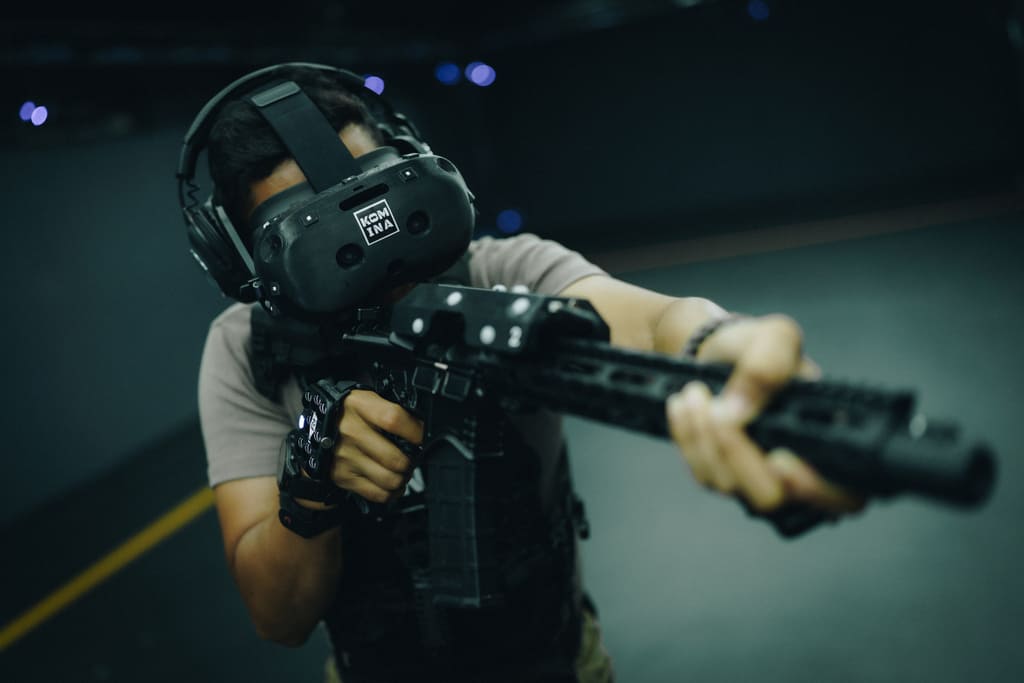
KOMINA’s armory lists biometric sensors among its wearable tactical gear, with heart rate tracking, stress analysis and performance metrics. Other wearables listed include a haptic vest with more than 40 impact zones and adjustable intensity, and tactical gloves with full finger tracking. KOMINA states that its equipment uses low-latency wireless connectivity, so trainees can move without cables restricting them.
Connecting Biometric Data to Performance
Heart rate data is most useful when compared with other session data. KOMINA’s after-action review provides a 3D replay, shot accuracy and grouping, reaction time, decision-making speed and threat identification time.
When heart rate is reviewed alongside these records, instructors can examine questions such as:
- Did accuracy change as heart rate increased?
- Did a decision error occur during a period of elevated stress?
- How did different team members respond to the same event?
The answers can help instructors decide whether a trainee needs more technical practice or more practice under pressure.
Interpreting the Data Carefully
Several factors should be considered when reading heart rate data:
Individual differences. Resting and working heart rates vary between people, depending on factors such as age and fitness. Comparing a trainee with their own previous sessions is generally more informative than comparing them with other trainees or a fixed value.
Physical effort. In KOMINA, trainees move physically in a free-roam space and carry weapon props. Physical activity raises heart rate independently of psychological stress. Instructors should consider what the trainee was doing when heart rate changed.
Context. A change in heart rate shows that the body responded to something. It does not explain the reason for a decision. The replay and debrief discussion remain necessary for that.
Recording a baseline session for each trainee at the start of a training program provides a reference for later comparison. This baseline should use a scenario that can be repeated later under the same conditions.
How KOMINA Creates Training Pressure
Measuring stress is useful only if the training produces it. KOMINA includes several features intended to increase physical and psychological load:
- free-roam movement, requiring trainees to walk and move physically
- modified airsoft-based weapon props with realistic weight and recoil
- electric shockbelt haptics for hit confirmation, with adjustable intensity
- a sandbox environment in which instructors can change threats, lighting and weather during a session
Tracking Change Over Time
KOMINA’s progress tracking stores individual and team results across sessions. Instructors can review how a trainee’s physiological response and performance change when they repeat similar scenarios over a training period.
Team-Level Review
Heart rate data can be reviewed for an entire team within one scenario. This allows instructors to see how each member responded to the same event, which can support individual feedback during the debrief.
Data Handling
Heart rate is personal physiological data. Units should define who can access it, how it is used and how long it is kept. KOMINA has published a separate article on data security in VR tactical training, which may be relevant to this question.
Summary
Heart rate and stress monitoring add physiological information to the performance data already recorded in KOMINA’s after-action review. Used together with the replay and the instructor’s own assessment, it can help identify how pressure affects each trainee. Instructors can contact KOMINA to see the monitoring dashboard in a demonstration.