Some events at a mine are so rare that a worker might go an entire career without seeing one — a serious fire, a major vehicle incident, a casualty that needs rescuing from a difficult position. That rarity is a blessing and, for training, a curse. Because these events almost never happen, the people who would have to respond almost never practise responding, so when the worst day finally arrives, the team meets it under-rehearsed, in chaos, with lives on the line. It is the cruel paradox of emergency preparedness: the situations that matter most are the hardest ones to train for.
Why emergencies resist conventional training
The problem isn’t a lack of effort. Mines run drills, hold tabletop exercises, and write detailed emergency response plans. But each conventional method hits a wall. A tabletop exercise — talking through the response around a table — builds familiarity with the plan but carries none of the pressure, confusion, or time compression of the real thing. A full live drill is far more realistic, but it’s disruptive, expensive, and can only be staged occasionally, which means the response team practises the full scenario a handful of times a year at most. And you simply cannot stage the most dangerous versions for real: you can’t set a genuine fire in an occupied area or simulate an actual collapse to see how the team reacts. The events that most need rehearsing are precisely the ones a live drill can’t safely reproduce.
What VR can put a team inside
This is the gap immersive training is built for. A VR emergency scenario can drop a response team into a fire, a vehicle incident, a confined-space casualty, or a site evacuation — and make them run the full response, under time pressure, in a reconstruction of their own site. Crucially, they can do it repeatedly. Instead of rehearsing the worst day once a year, the team can work through it monthly, varying the scenario each time so they’re solving a fresh problem rather than reciting a memorised one.
What gets trained here isn’t just procedure — it’s the things that actually break down in real emergencies: decision-making under pressure, coordination between team members, clear communication, and getting the sequence right when adrenaline is high and information is incomplete. Those are skills, and like all skills they’re built through repetition that a once-a-year drill can’t provide.
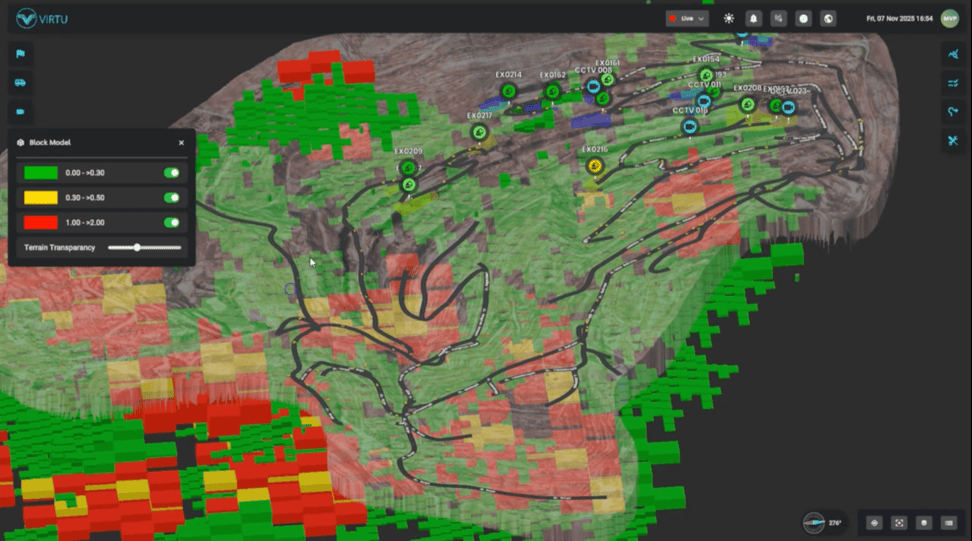
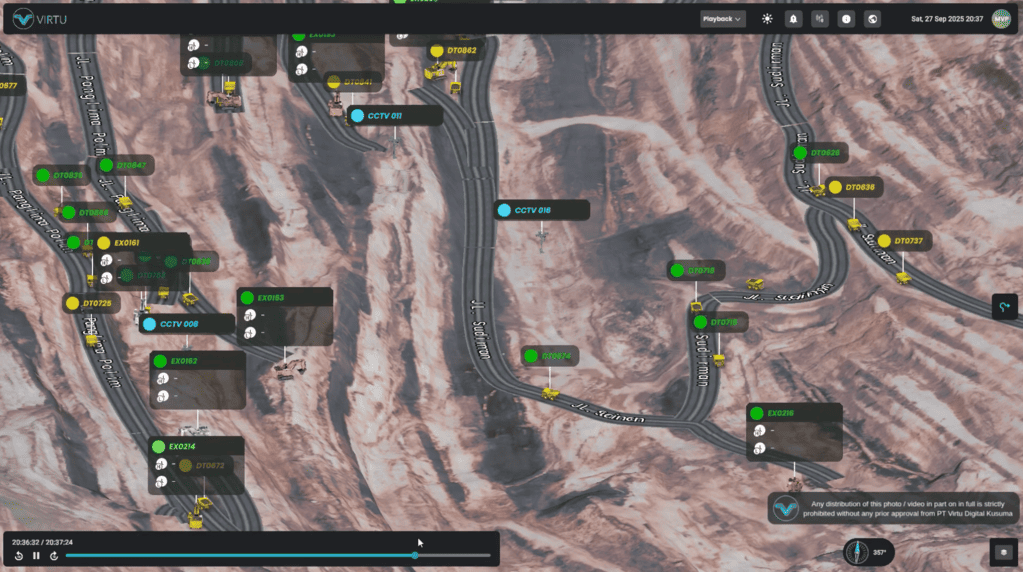
Indonesian developer Virtu has applied exactly this approach in its VR and digital-twin safety work, including emergency response, evacuation, and mine-rescue scenarios built inside accurate models of real underground operations. The premise is simple: let a response team make their mistakes in a simulation — take the wrong route, miss a step, lose track of a teammate — and learn from them there, rather than discovering those mistakes for the first time during an actual emergency.
The debrief emergencies never used to have
There’s a second advantage that’s easy to overlook. After a live drill, the debrief depends on what a handful of observers happened to notice in the confusion. After a VR scenario, the system has the record — who did what, how long the response took, where coordination broke down, which decision cost critical seconds. For an event where seconds genuinely decide outcomes, being able to review the response objectively, point to the exact moment it faltered, and run it again is worth as much as the rehearsal itself.
Where the simulation stops
It’s important not to oversell this. VR can’t reproduce the full physical and emotional weight of a real emergency — the heat, the genuine fear, the bodily exhaustion of a real rescue. It doesn’t replace the hands-on training a rescue team needs with real equipment, and it doesn’t build the physical capability that live drills and proper ERT preparation provide. A headset won’t make a mine rescue team.
What it does is fix the specific weakness at the heart of emergency preparedness: that the most critical responses are practised the least. By making it cheap and safe to rehearse the worst day as often as the team needs, VR turns a once-a-year scramble into a drilled, familiar routine — so that if the real emergency ever comes, it isn’t the first time the team has faced it.
The best-prepared mine isn’t the one with the thickest emergency plan. It’s the one whose people have already lived through the emergency — even if only in a headset.