Heavy equipment operator training in mining sits at the intersection of three concerns: safety risk, operational productivity, and capital cost. Operators handle multi-million-dollar machines in dynamic, often hazardous environments. Errors carry consequences across all three dimensions — injury risk to the operator and surrounding personnel, damage to expensive equipment, and lost productivity that compounds across the operation.
Conventional operator training has worked for decades. It remains the foundation of operator development pipelines. It also has well-documented constraints, and VR-based training is increasingly used to address them.
This article walks through how virtual training applies to mining heavy equipment operators in Indonesia, with focus on the three equipment categories where the operational case is strongest: excavators, haul trucks, and draglines.
The Operator Training Problem in Indonesian Mining
Indonesian mining operations run some of the largest heavy equipment fleets in the region. BUMA, PAMA, Petrosea, United Tractors, Indo Tambangraya Megah, and other major operators collectively run thousands of haul trucks, hundreds of excavators, and a smaller number of draglines and large mining shovels — across coal and metal mining operations.
Operator training across this fleet faces several structural challenges.
Equipment availability is constrained. A haul truck assigned to training is a haul truck not producing tonnage. The opportunity cost is significant, particularly for mature operators who’d otherwise be in production. Operations balance training requirements against production targets, and often training depth gets compressed.
Training environments are hazardous. Live equipment training puts operators with limited proficiency on expensive equipment in operational environments. Even with experienced trainers and graded exposure, the risk profile is real. Equipment damage, near-misses, occasional serious incidents — these are documented training outcomes that any honest operator development program acknowledges.
Skill development is non-linear. New operators move through stages: equipment familiarization, basic operations, productive operations, advanced techniques, hazard response. Each stage needs different exposure types. Early stages benefit from low-stakes practice that live training can’t cost-effectively provide. Advanced stages benefit from scenario variety that operations can’t stage on demand.
Certification sets a floor but doesn’t define depth. Indonesian mining operations work under Kepmen ESDM No. 1827 K/30/MEM/2018 and related regulations covering operator competency for heavy equipment. Operators hold SIO (Surat Izin Operator) certifications appropriate to their equipment class. Certification confirms minimum competency. It doesn’t define the depth of skill development that separates excellent operators from minimally certified ones.
These structural challenges create specific gaps. VR-based training produces operational value in those gaps, particularly across the equipment categories that dominate Indonesian mining work.
Excavator Operator Training
Excavators — hydraulic excavators, mining shovels, and backhoes in mining configurations — are the primary loading equipment in most Indonesian open-pit operations. Komatsu PC2000, PC3000, PC4000, Hitachi EX1900, EX2600, EX3600, Liebherr R9400, R9800, and similar large-class machines define the workload of mining excavator operators.
Training challenges specific to excavators. Operators have to develop bucket control across complex bench geometries, optimize loading patterns for different haul truck configurations, manage swing radius and counterweight dynamics, read ground stability changes during digging, and coordinate with haul truck operators in tight loading positions. Cognitive load is high — particularly for operators new to large-class machines.
Spatial judgment is the dominant skill. An operator’s ability to read the bench, estimate truck positioning, time the swing cycle, and place buckets accurately determines productivity by significant margins. This skill develops through repetition. Operations want their operators to build it without the productivity cost of slow new-operator cycles, and without the equipment damage risk of new operators learning at the working face.
What VR delivers for excavator operators. VR-based excavator simulators reproduce the cab environment — joystick controls, monitor displays, foot pedals, switch panels — with layout matching the actual machine. Operators run through standard operations: digging cycles across different bench configurations, truck loading patterns, ground control awareness, hazard response.
Scenario variety addresses what live training can’t match. Bench configurations vary across the simulation in ways live operations don’t replicate quickly. Truck operators in the simulation behave with the realistic variation of actual operators. Weather, visibility, and environmental conditions can be adjusted. Hazard scenarios — ground instability indicators, equipment proximity issues, communication breakdowns — get drilled without operational risk.
The repetition unlock matters. New operators can run hundreds of digging and loading cycles in VR before approaching live equipment. Mature operators can drill specific scenarios — particular bench configurations, unfamiliar truck types, complex coordination situations — without taking working equipment out of production.
What VR doesn’t replace for excavator operators. Tactile feel of actual hydraulic response. Vibration cues that experienced operators read for ground and equipment condition. The physical fatigue of long shift operations. The dust, heat, and noise of the actual cab environment. VR builds the procedural and decision-making layers that make live training more efficient. It doesn’t substitute for the sensory adaptation that only live operations develop.
Haul Truck Operator Training
Haul trucks dominate the equipment count and the operator workforce in most Indonesian open-pit operations. Caterpillar 793, 797, Komatsu HD785, HD1500, 930E, 980E, Hitachi EH3500, EH5000, and similar ultra-class trucks make up the bulk of fleet operations. Smaller-class trucks handle specific applications.
Training challenges specific to haul trucks. Haul truck operation looks straightforward from outside the cab. The operational reality is more demanding. Operators have to navigate haul roads with constantly changing conditions, manage truck dynamics through grades and curves, coordinate with loading equipment at the face, sequence properly at dump points, manage retarder usage and brake heat on long descents, read tire and chassis condition through cab feedback, and respond to emergent hazards across long shifts.
Productivity per truck is measured carefully in mining operations. Operator differences across the same fleet can vary tonnage delivered by 10-15% across a shift. Multiplied across a fleet of 50-100 trucks over a year, the difference compounds into significant production variance. Operator development is tied directly to operational economics.
Safety risk varies across the operational profile. Loaded descents on long haul roads, intersection coordination, refueling and maintenance positioning, dump point sequencing, night operations — each carries a distinct risk profile. Operators encounter each profile across operational cycles, but edge-case frequency is too low for conventional training to drill comprehensively.
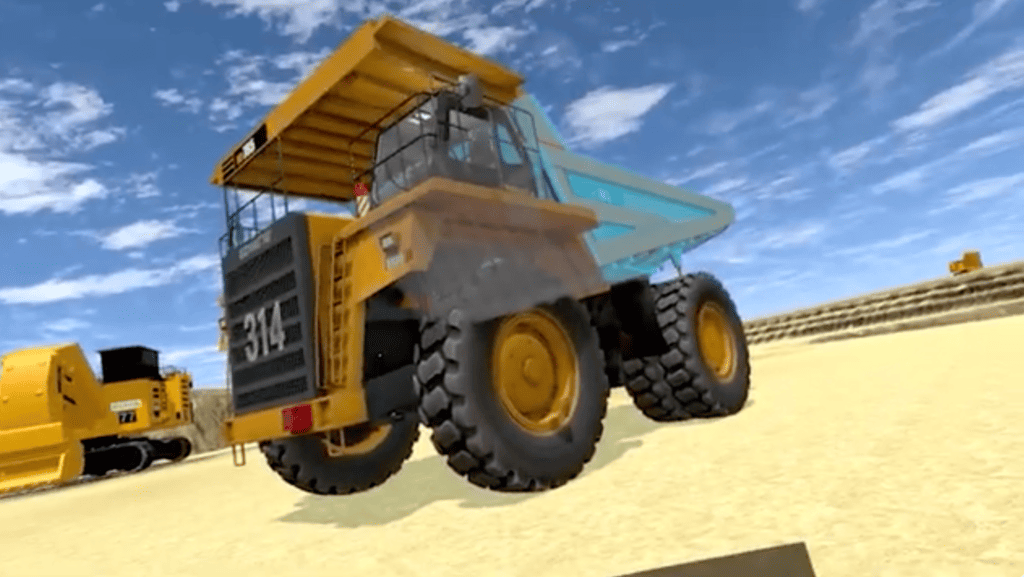
What VR delivers for haul truck operators. VR haul truck simulators reproduce the cab environment with controls, displays, communication systems, and visibility profile matching the actual truck class. Motion platforms paired with VR simulate truck dynamics — body movement, retarder feel, suspension response — providing the physical feedback that pure visual simulation can’t.
Scenarios address operational variety that conventional training can’t stage. Different haul road profiles. Weather conditions. Traffic patterns. Loading equipment behaviors. Dump point configurations. Emergency situations. New operators develop foundational skills without burning fuel or putting equipment at risk. Mature operators drill specific scenarios — adverse weather operations, unfamiliar haul routes, equipment limp-mode response — that aren’t part of routine operations.
For operations running multi-class fleets, VR enables cross-equipment familiarization. An operator certified on one truck class can familiarize with another in simulation before transitioning, which reduces transition risk and accelerates fleet flexibility.
Featured work from Indonesian VR specialists in this space includes Heavy Duty Mining Vehicles VR Training, focused on familiarizing HD unit operators before they enter the actual cab. The application aligns directly with the operational gap conventional training has the hardest time closing.
What VR doesn’t replace for haul truck operators. The full sensory load of multi-hour operations. The fatigue management skills that develop only through actual shift work. Real haul road condition assessment under specific operational conditions. Trust-building between operators and dispatch that happens in real operations. VR is the foundation layer. Live operations build on top of it.
Dragline Operator Training
Draglines are the most operationally specialized of the three equipment categories. Bucyrus 8200, 8750, P&H 9020C, 9160, Marion 8200 series, and similar walking draglines run in a smaller number of Indonesian coal operations — primarily in overburden removal in larger-scale strip mining contexts.
Training challenges specific to draglines. Dragline operation is a low-frequency, high-skill activity. The number of dragline operators in Indonesia is small — measured in dozens, not thousands. Training pipelines are constrained by the limited number of senior operators who can teach, the slow pace of skill development on actual machines, and the operational priority of keeping draglines productive.
The skill itself is complex. Operators manage multiple coordinated systems — boom positioning, drag control, hoist control, bucket dump cycles, walk maneuvers — across long cycle times. Productivity per dragline is enormous, which means operator differences translate directly into significant operational variance. A single dragline produces overburden removal on the scale of multiple haul truck fleets, which makes operator quality strategically important.
Walk maneuvers in particular are infrequent but critical. Draglines walk to reposition along the working face, and walk operations carry distinct risk profiles. Operators encounter walk maneuvers infrequently in routine operations, which limits the repetition needed to develop confident execution.
What VR delivers for dragline operators. VR dragline simulators address the access problem that constrains operator development. Trainees can spend extended time in simulated cabs running standard operating cycles — boom swing, drag, hoist, dump, return — without occupying actual dragline production time. Walk maneuvers can be rehearsed across configurations that wouldn’t be feasible to stage live.
Scenario variety addresses what conventional training has the hardest time providing. Different working face geometries. Ground conditions. Weather scenarios. Equipment failures. Emergency response situations. New operators develop foundational competency before approaching the actual machine. Mature operators refresh skills periodically without taking the dragline out of production.
For operations with succession planning challenges — senior dragline operators approaching retirement with a limited junior operator pipeline — VR enables accelerated development of replacement operators. The skill transfer doesn’t fully replace mentorship and live experience, but it dramatically shortens time to operational competency for the procedural and decision-making layers.
What VR doesn’t replace for dragline operators. The physical scale of dragline operation. Hours spent in the cab developing the rhythm and timing that distinguish productive operators. The mentorship from senior operators that transfers tacit knowledge VR can’t capture. High-stakes decision-making under real operational consequences. VR builds the foundation. Senior operator mentorship and live operations build the rest.
Common Operational Benefits Across All Three Categories
Pulling the three equipment types together produces a clearer view of the operational pattern.
Reduced training time on production equipment. Operators develop foundational competency in VR before approaching live machines. This produces measurable reductions in equipment downtime for training, fuel consumption during development phases, and damage rates during the early operator learning curve.
Faster progression to productive operations. Operators arrive at live equipment with procedural fluency, basic decision-making patterns, and familiarity with the cab environment. The progression from initial cab assignment to productive operations shortens, which accelerates the operator’s contribution to fleet output.
Reduced damage during early operations. New operators damage equipment. Damage rates differ across equipment classes and operations, but the pattern is consistent — operators in their first hundred hours on a new machine class produce more damage incidents than experienced operators. VR pre-training reduces this rate by building foundational competency before live exposure.
Scenario variety beyond what live training can deliver. Operations stage the scenarios their operational reality includes. Edge cases, emergency situations, unusual conditions, rare equipment configurations — these are difficult to drill conventionally. VR enables comprehensive scenario coverage.
Performance measurement and operator development. VR sessions produce telemetry on operator performance: cycle times, control input patterns, decision points, error rates. Aggregated across operators and over time, this data supports both individual development and program-level optimization. Conventional training relies on instructor observation. Instructor observation is valuable, but it doesn’t aggregate.
Cross-equipment familiarization. Operations running mixed fleets benefit from operator flexibility. VR allows operators certified on one equipment class to familiarize with another before live transition, which reduces transition risk and accelerates fleet adaptability.
Skill retention during downtime. Operators on rotational schedules, returning from leave, or transitioning between sites can refresh skills in VR before returning to production. Skill decay during time away from equipment is a real factor in mining operations. VR addresses it without requiring access to the actual equipment.
Integration With Indonesian Operator Certification
VR training fits within the Indonesian operator certification framework. It doesn’t compete with it.
SIO (Surat Izin Operator) certification continues to come from accredited pathways — Kementerian Tenaga Kerja-recognized training centers, equipment manufacturer certified programs, BNSP-recognized providers. Kepmen ESDM No. 1827 K/30/MEM/2018 and related regulations define the operator competency standards. VR training is not an accredited certification path.
Where VR fits is in the development layer that supports certification. Pre-certification training prepares operators for the certification assessment with foundational competency that conventional pre-training can’t match cost-effectively. Post-certification skill development, refresher training, and scenario variety drilling extend operator capability beyond the certification minimum. Cross-equipment familiarization for operators expanding their certification portfolio reduces transition risk.
The audit benefit matters operationally. Indonesian K3 Pertambangan requirements include documentation of personnel competency for safety-critical activities, including heavy equipment operation. VR session telemetry produces auditable competency records that supplement attendance documentation, supporting compliance with Direktorat Jenderal Mineral dan Batubara (Minerba) audit requirements.
For operations running their own operator development programs, VR provides infrastructure that scales without proportional cost increases. New operator pipelines, refresher cycles for mature operators, and specialized training for high-skill equipment classes — all run on the same underlying VR platform, with content modules adapted to each equipment type.
Practical Considerations for Deployment
Several factors affect how successfully VR operator training programs deploy in Indonesian mining contexts.
Equipment-specific accuracy matters. A haul truck VR module that doesn’t match the actual cab layout, control configuration, and operational characteristics of the operation’s truck fleet produces transferable skill at lower fidelity than a module built specifically to the operation’s equipment. Indonesian mining operations run a diverse equipment portfolio across manufacturers. VR content scoped to actual fleet composition produces better results than generic content.
Motion platform integration matters for haul trucks and large equipment. Static VR provides procedural and decision-making development. Motion platforms paired with VR add the physical feedback dimension that approximates actual equipment dynamics. The cost difference is meaningful — but for haul truck and dragline operators, the training value of motion platforms justifies the investment in serious programs.
Local content development matters for sustained relevance. Mining operations evolve. Equipment fleets change. Operating conditions shift. Programs supported by local engineering and content development capacity adapt to ongoing operational changes more cleanly than programs dependent on remote international support.
Bahasa Indonesia integration matters operationally. Indonesian mining operator workforces are predominantly Indonesian-speaking. VR content with Bahasa Indonesia voice prompts, control labels, and instructional content integrates into existing training programs with less friction than imported English-only content.
Pilot scope matters for adoption. Programs that start small — single equipment class, defined operator group, measured timeframe — produce better adoption than ambitious all-fleet deployments. Successful pilots create the operational evidence and stakeholder buy-in that supports broader rollout. Unsuccessful ambitious deployments often fail not for technical reasons but because the organization couldn’t absorb the change at the scale attempted.
These considerations apply broadly across Indonesian mining operations. Each operation has specific circumstances that affect implementation. The structural factors above show up consistently across deployments.
Virtu is an Indonesian XR and Industry 4.0 company with a substantial portfolio in mining technology applications. The company’s mining client base includes BUMA (Bukit Makmur Mandiri Utama), PAMA, Petrosea, United Tractors, and Indo Tambangraya Megah — covering major segments of the Indonesian mining sector.
Featured work directly relevant to heavy equipment operator training includes Heavy Duty Mining Vehicles VR Training, focused on familiarizing HD unit operators before they enter the actual cab. The same platform infrastructure supports broader mining applications, including Smart Digital Twin Mining for coal mine operations, working at height safety scenarios, and other industrial training applications.
Virtu’s process for operator training engagements moves through four stages: Diagnose (understanding the operational requirement and matching training scope to actual gap), Design (architecting training scenarios and integration with existing operator development programs), Develop (building modules with equipment-specific accuracy), and Deploy (installation, testing, operational handover).
The company is Indonesian-based, with engineering and project delivery capacity in-country. This matters for operator training work that requires sustained collaboration with site operations, training departments, and equipment-specific configuration. Voice prompts and UI default to Bahasa Indonesia, with English available for multinational operations. Implementation work for heavy equipment operator training can be scoped to specific equipment classes, integrated with existing K3 Pertambangan documentation, and aligned with the operation’s operator development pipeline.
For training scoping conversations, capability briefings, or pilot deployments specifically focused on heavy equipment operator training, Virtu can be reached through the contact form at https://virtu.co.id/ or via WhatsApp at +62 812 9696 7887.